
One Voice. All Devices.
Powered by the HiSilicon WS63 RISC-V SoC, running OpenHarmony lightweight kernel, wired into NearLink (SLE 1.0) — a desk-class AI companion that's open source from die to display.
- PWR
- NET
- SLE
# 1. Pull the OpenHarmony tree
$ repo init -u https://atomgit.com/xiaohong-ai/manifest
$ repo sync -c

# 2. Build the RISC-V image
$ hb set xiaohong && hb build -f

# 3. Flash & wake
$ ./flash.sh /dev/ttyUSB0 ✓
An open-source AI unit for your desk
A 47×47×20 mm cube of hardcore: OpenHarmony plus RISC-V at the core, with NearLink, Wi-Fi 6, and BLE 5.2 stacked into a single die. "Speak once, the room responds."
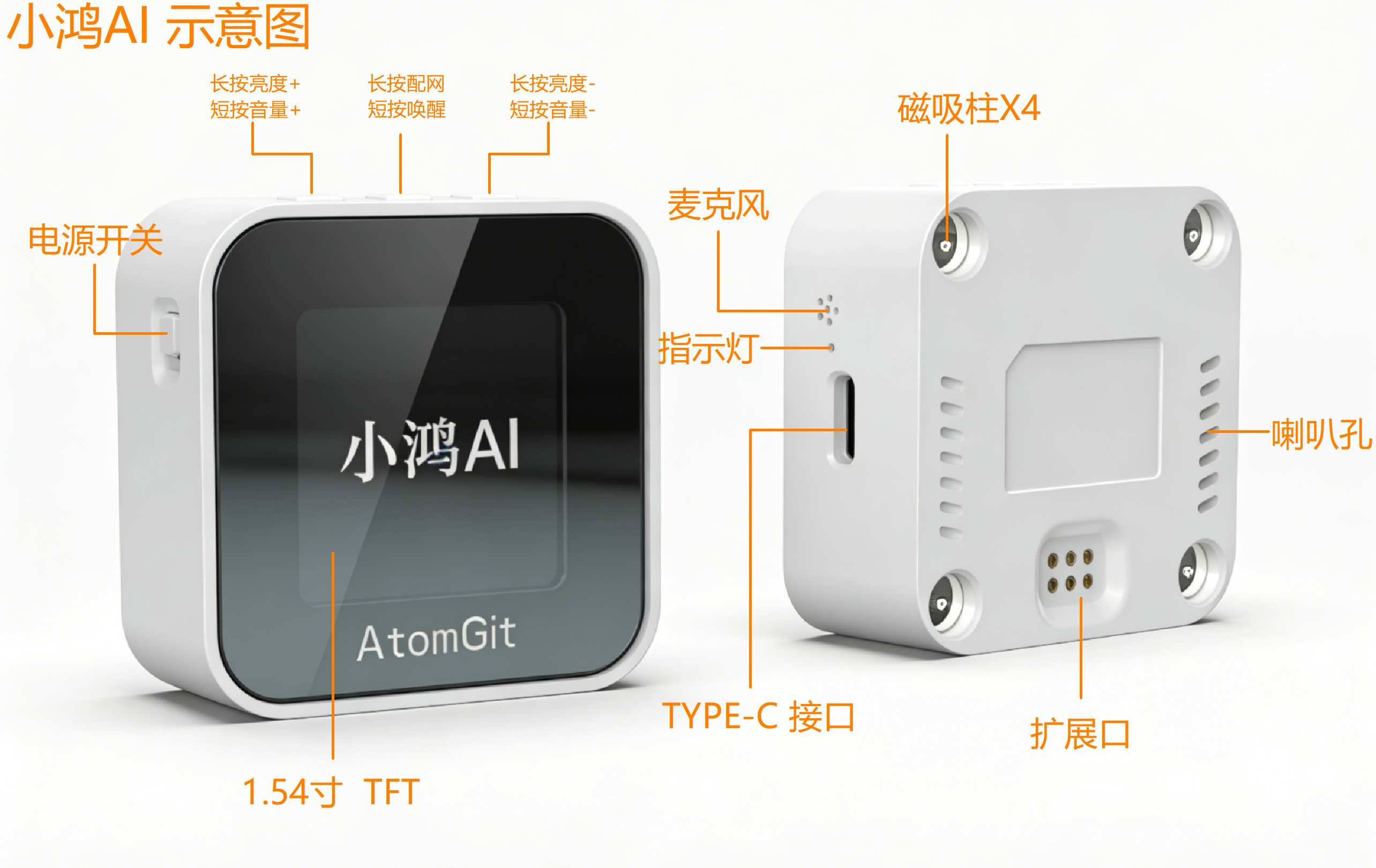
1.54" TFT · 240×240
High-contrast display drives wake-up animations, expressions, and live system state.
4× magnetic posts + USB-C
Snap-on dock with magnetic corners. Type-C 2.0 carries both data and power.
UART / I²C / GPIO breakout
Three reserved standard interfaces — solder one wire and own every IoT peripheral in the house.
Single mic + 1.2 W speaker
On-device wake (CI1302) plus online LLM dialog — a steady "edge + cloud" voice pipeline.
Three chips, one stack — open all the way down
From SoC to radio, from voice DSP to operating system — every layer is readable, modifiable, and flashable.
Main control · multi-mode IoT SoC on RISC-V
32-bit RISC-V core up to 240 MHz, 606 KB SRAM, 300 KB ROM, 4 MB on-chip Flash plus 16 MB external. Wi-Fi 6, BLE 5.2 and NearLink integrated on a single die — three radios, one chip.
- 240 MHz max clock
- 4 + 16 MB Flash
- 3-in-1 radio
Voice · on-device ASR NPU
Chipintelli CI1302 voice-recognition NPU drives single-mic far-field wake without any network. Pairs with cloud LLMs to form a robust "edge + cloud" dialog pipeline.
- Local wake
- Low-power NPU
- Dual-path dialog
OS · lightweight OpenHarmony kernel
OpenHarmony 7.0 mini system — distributed soft-bus, HUKS security, full driver stack. Everything from boot to BSP to peripherals is open: the source is the documentation.
- Mini kernel
- HUKS security
- Full-stack OSS
Specs · data is the truth
Small cube, no compromise. Every spec below comes from the official PCB and SCH — all hardware files are in the public repo.
14 hands-on demos · no shortcuts
From HelloWorld to SLE UART pass-through — RTOS primitives, peripherals, and full wireless stack. Each demo ships with complete source and flashing notes.
Hello World
Minimal project · boot · serial print
Software timer
Periodic callbacks · one-shot timers
Delay
Millisecond / microsecond blocking delay
Mutex
Cross-task resource protection
Semaphore
Sync primitive · counting
Message queue
Inter-task FIFO communication
SPI Master
SPI master mode · high-speed I/O
Easy Wi-Fi
One-tap connect · DHCP · Ping
Speaker
PCM playback · volume control
PWM
Breathing LED · duty-cycle control
STA mode
Wi-Fi station · reconnect logic
Event
Event flags · multi-event wait
Sync semaphore
Two-task coordination pattern
SLE UART tunnel
NearLink short-range · device pairing
VibeCoding Signal Light
Agent Status Sync / HTTP Hook Traffic Light
Four steps · blank board to wake word
Mac or Windows, your call. All source, images, and flashing tools live in AtomGit.
-
01
Set up dev environment
Ubuntu 22.04 recommended · 16 GB+ RAM · VSCode + Remote-SSH. Host OS can be Windows or macOS.
$ sudo dpkg-reconfigure dash # → bash -
02
Sync + build sources
Use manifest to pull the full OpenHarmony tree plus the xiaohong vendor. Build RISC-V images with hb.
$ repo init -u https://atomgit.com/xiaohong-ai/manifest -
03
Flash to device
CH341 serial + UartAssist / BurnTool on Windows, or burn.sh on macOS — one command to the WS63.
$ ./burn.sh -p /dev/ttyUSB0 -f out.bin -
04
Run a demo · say hello
Pick a sample under
vendor/atomgit/xiaohong/.../samples/, add to BUILD.gn, reflash. Open serial at 115200.> HEY XIAOHONG ... [WAKEUP OK]
Fully open source · all code on the table
Ten-plus repos covering chip drivers, OS adaptation, peripheral modules, security, graphics, and audio. PRs always welcome.
Xiaohong AI documentation hub · OpenHarmony & NearLink references
15 complete example projects: RTOS, peripherals, networking
repo sync entry point — pulls the entire Xiaohong OpenHarmony tree
HUKS security component · key storage & trusted execution
WS63 dev environment · vendor adaptation layer
LVGL lightweight graphics · OpenHarmony port
HiSilicon chip drivers & HDI implementations
IoT peripheral control · GPIO / I²C / SPI / PWM
Opus audio codec · real-time voice encoding
Xiaohong dev-board BSP · board-level adaptation
On giants' shoulders, with partners forward
Xiaohong AI is co-built by AtomGit with 60+ silicon partners and 10+ top universities. From silicon to OS, from radio stack to classroom — every layer ships with first-party open-source contributors.
CHIPS & ECOSYSTEM Silicon & ecosystem partners
UNIVERSITIES First batch of AtomGit Open Source Institutes
Building the AtomGit open-source ecosystem with 50+ universities and 60+ chip vendors. We'd love to have you.